A Winter Window for Watching Bird Silhouettes
A winter window for watching bird silhouettes turns brief visits into a calm record of shape, movement and timing, without demanding a name for every bird.
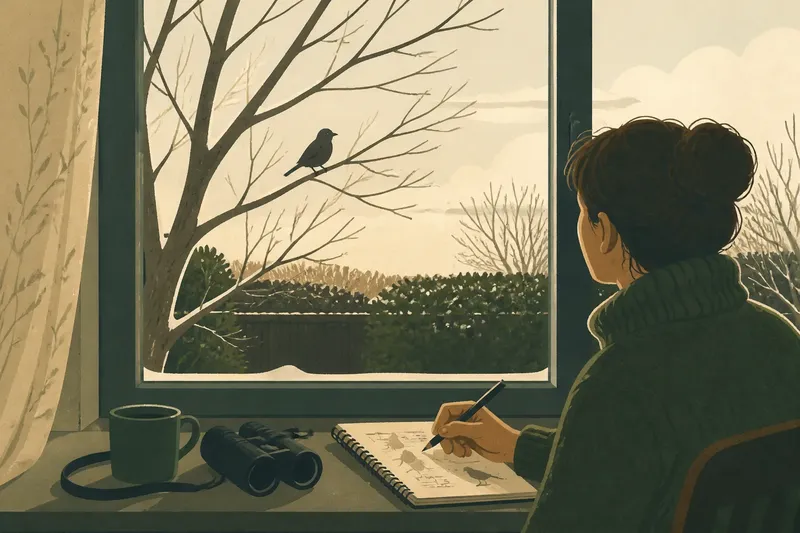
At the kitchen window, a small bird lands on the bare lilac, pauses, then darts below the sill. A winter window for watching bird silhouettes makes that brief visit enough: notice its outline, movement and timing, and let the bird remain unnamed if that is all the view offers.
This is a quiet routine for a cold week, not a test of identification. Choose one window with a clear view of a tree, hedge, fence or patch of open sky, then return to it at roughly the same parts of the day. The changing light and the birds’ own comings and goings will supply plenty to notice.
Which window makes a useful viewing spot?
Pick a place where you can sit comfortably and watch without opening the window or disturbing the birds. A view across a garden, courtyard or nearby green space works well, especially if it includes both a perch and an open route through the air. The aim is not to see every detail; it is to see a shape against a background.
Look for a contrast that helps the outline stand out. A dark bird against pale winter sky may be easy to follow, while a pale bird can show clearly against evergreen foliage or a shaded fence. If the glass reflects the room, shift your chair or draw a curtain behind you. You can also turn off a nearby lamp when daylight is fading.
Keep a small notebook and pencil on the sill or beside your chair. A simple sketch can be more useful than a long description: a round body, a long tail, a short neck, a pointed bill. You need not draw neatly. A silhouette is a few relationships between shapes, like the shadow of a coat hanging on a peg.
What should you notice before reaching for a name?
Start with the whole outline. Is the bird compact or stretched out? Does its head seem large beside its body? Is the tail short, long, forked-looking or held at an angle? These are observations, not conclusions, and they remain useful even when the light makes colour and fine markings hard to see.
Then watch how the bird uses its shape. A visitor may sit upright, hunch low, grip a twig, hop along a branch or flick its tail as it moves. In flight, note whether it travels in a straight line, rises and dips, or makes a quick turn around a tree. A single movement can be hard to read; a repeated pattern gives your eye something firmer to record.
Separate what you saw from what you think it might mean. Write “long tail held level” rather than “probably a wagtail” if you are unsure. This keeps the notebook honest and makes it easier to compare later sightings without forcing them into a label.
How can you build a week of quiet observations?
Keep the routine light enough to fit an ordinary day. A few minutes at a familiar window can reveal more than a long session spent waiting for a particular bird. If a day is cloudy or empty, record that too; a quiet view is part of the week’s pattern.
- On the first day, choose your view. Note the window, the visible perches and the time of day. Make a quick sketch of the scene so later notes have a setting.
- On the second day, watch for stillness. Record where birds pause and how they hold their bodies. Notice whether they face into the wind, crouch or keep changing position.
- On the third day, follow movement. Watch how a visitor arrives and leaves. Mark whether it hops, runs, flutters between branches or crosses the view in one quick flight.
- On the fourth day, listen as well as look. Add a short note if a call or wing sound catches your attention, but do not let sound replace the silhouette. A bird hidden behind a hedge can still be part of the scene.
- On the fifth day, compare outlines. Sketch two visitors side by side if their shapes differ. Focus on proportions—body, head, bill and tail—rather than trying to make a species portrait.
- On the sixth day, notice the setting. Has frost, rain, wind or a change in daylight altered which branches are visible or where birds pause? Write down the condition without assuming it explains every visit.
- On the seventh day, read your notes slowly. Look for a repeated time, perch or movement. Circle the details you observed clearly and leave uncertain guesses uncircled.
You can shift the days to suit your schedule. If morning is busy, choose a calm stretch in the afternoon and keep returning then. The useful thread is a familiar view and a record that distinguishes direct observation from interpretation.
What can a repeated visit reveal?
A single arrival is a moment; repeated visits create a small sequence. You may notice that the same branch is used at different times, that a bird pauses before crossing an open gap, or that the view becomes busier when the light changes. These are modest observations, but they give the scene structure.
Say you have a bare apple tree outside the window and see a compact silhouette there on three afternoons. You note its upright pauses, short hops and quick departure towards the hedge, without assigning a species. By the end of the week, the expected observable result is a clearer record of how that visitor moves through the view—not a confirmed identity.
Keep weather and light notes brief. “Gusty; branches moving” is more useful than trying to explain why a bird chose one perch. Likewise, a bird’s absence from the window does not mean it has disappeared from the area. Your view is only one small opening onto a larger landscape.
How can you make the notes useful without turning them into a quiz?
Use a consistent shorthand, but leave room for ordinary words. A line might read: “Late afternoon; slim outline; tail long; two hops; flew low towards hedge.” If a feature was obscured, say so. “Bill unclear in glare” is a good observation, not a failure.
For sketches, draw the body first, then add the head, tail and bill in proportion. Use arrows for direction of travel and a small mark for the perch. If several birds appear at once, sketch only the one you can follow; trying to capture the whole scene can make you miss the movement that interested you.
A field guide can be useful later, once you have written down what was visible. Compare your notes with illustrations or descriptions, but treat any match as a possibility unless the view offered enough detail. The activity works just as well when the notebook contains shapes and habits rather than names.
What questions come up during silhouette watching?
Do I need binoculars?
No. A clear view from indoors is enough for this activity, and binoculars can pull your attention towards details that are difficult to judge through glass. If you already use them, keep the session centred on the outline and movement you can actually see.
What if I cannot tell one bird from another?
Record the features that remain clear, such as body shape, tail position, perch or direction of flight. Repeated notes may show that two visits looked different, even if neither bird receives a name.
Should I put food outside the window?
Not for this routine. Watch the birds already passing through the view, and avoid changing their behaviour just to bring them closer. If you maintain a feeder for other reasons, follow local guidance and keep it clean.
Is a window safe for birds to approach?
Birds can collide with reflective or transparent glass, so take the risk seriously if they regularly fly close to the pane. Follow local wildlife guidance on making glass more visible to birds, and consult a qualified wildlife professional if collisions continue or a bird appears injured.
When should the week’s routine end?
Stop when the notes begin to feel repetitive, or keep the window as an occasional pause through the rest of winter. There is no need to complete every day in order. A missed session is simply a gap, and the next clear view can begin the record again.
At the end of a week, choose one sketch or sentence that captures what you had not noticed before: perhaps a tail that steadies a turn, a pause on an exposed twig, or the way one silhouette vanishes behind the hedge. A winter window for watching bird silhouettes is most rewarding when it leaves you with a sharper eye for the next brief visit—and no pressure to name it before it is gone.