The Myth That a Fallen Log Is Just Dead Wood
A fallen log is more than dead wood: learn to read its changing bark, damp hollows and softening heart as signs of a living habitat.
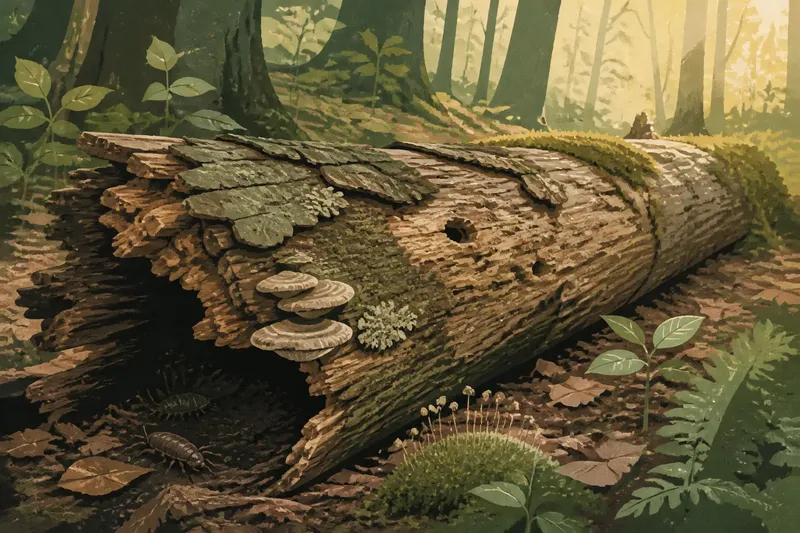
A fallen log is more than dead wood. Look closely at a trunk laid across a woodland floor and you may find bark lifting like loose roof tiles, a dark seam holding moisture, and tiny plants rooted where the wood has softened. The tree has stopped growing, but its material is entering a new, busy phase.
What changes when a tree falls?
Standing trees offer shade, shelter and feeding places; fallen ones bring these features down to ground level. Their surfaces meet soil, leaf litter and passing water, while gaps beneath the trunk become sheltered pockets. The result is not one uniform habitat but a patchwork that shifts along the log and over time.
At first, much of the wood may still be firm. Bark can remain attached, and the trunk’s shape is easy to recognise. Later, fungi and small invertebrates help break down the wood; as fibres loosen, rain and fallen leaves collect in its crevices. Eventually, a heavily decayed trunk may blend into the forest floor.
Think of the log as a wooden sponge with a rough roof. Its bark catches rain and slows drying, while cracks and hollows hold dampness. That contrast matters: the exposed upper surface can be dry and sunlit, while the underside stays cool and moist.
Where should you look for small signs of life?
Start at the boundary between wood and ground. A slight gap beneath a trunk can shelter beetles, woodlice and other small animals from direct sun and wind. Look without lifting the log; turning it can disturb the residents and damage the damp layer that has gathered underneath.
Then scan the bark. Fungal growth may appear as a shelf, a crust or a patch of fine threads, depending on the species and its stage of growth. Mosses and lichens may occupy the outer surface, especially where light and moisture suit them. Their presence is not a simple clock: a log’s position, tree species and local conditions all shape what settles there.
Check the wood itself for galleries and small holes. These can mark places where insects have fed or emerged, though a hole alone does not identify its maker. Pale, crumbly wood and darker, softer patches reveal different textures of decay; the transition between them is often more interesting than the log’s most dramatic feature.
Why does the log’s position matter?
A trunk lying in open sun dries differently from one tucked beneath a dense canopy. The sunlit log may warm quickly and support life adapted to drier surfaces; a shaded one may retain dampness for longer. Neither is a richer story by default. Compare the signs that each setting allows you to see.
Species and shape matter too. Thick bark can make deep shelter; a smooth, narrow trunk may offer fewer cracks. A log resting on uneven ground creates more sheltered gaps than one pressed closely against the soil. Even the direction of the trunk can change which side receives light and rain.
Say you find two fallen trunks beside a woodland path: one lies in a bright clearing, the other under beech shade. If you note the bark, surface moisture and nearby moss on each without touching them, you might expect the shaded trunk to show more damp-loving growth, while the clearing trunk has warmer, drier patches. The comparison is a way to sharpen observation, not a prediction that every log will follow the same pattern.
How can you read a fallen log without disturbing it?
- Look along the whole trunk. Notice how bark, cracks and softness change from one end to the other.
- Check the light. Record whether the log sits in sun, shade or a mixture.
- Observe the underside from the edge. Look for a sheltered gap, but leave the trunk in place.
- Notice nearby plants. Moss, seedlings and leaf litter can show how the log meets the surrounding ground.
- Return after rain. Compare which surfaces remain visibly damp and where water gathers.
- Keep a small sketch. Mark the log’s shape and the positions of visible fungi or other growth; avoid collecting them.
These notes make a repeat visit more rewarding. A new patch of fungal growth, a loosened strip of bark or a seedling in a crack can mark a change without requiring you to handle anything. If you cannot identify a small animal or fungus, describe its shape and position rather than guessing at a name.
What do people often ask about fallen logs?
Is a fallen tree still alive?
The tree itself is no longer growing once it has fallen and died, but parts of its tissues may remain moist for a time. The trunk can still support living organisms that feed, shelter or grow on it.
Why do fungi grow on dead wood?
Many fungi use dead wood as food, breaking down its tissues as they grow. Their visible forms may appear on the surface, while much of the fungal body can spread through the wood.
Should I move a log to see what is underneath?
It is better to observe from the edges. The space beneath a log can shelter small animals and hold a damp layer, both of which may be disrupted when the trunk is moved.
Can a fallen log help young plants grow?
As wood softens, it can hold moisture and provide a surface where seeds or seedlings find a foothold. Whether plants establish there depends on light, water, the wood’s condition and the surrounding habitat.
What is the most useful detail to remember?
Read a fallen log as a sequence of surfaces, not as a single object: dry bark, damp crevice, soft heart and shaded underside may sit close together. That is the heart of the fallen-log habitat, and the reason “dead wood” can be a misleadingly quiet name.
Next time you pass one, choose a single crack or change in texture to revisit. The log may look much the same from the path, yet that small section can reveal how weather, decay and living things keep remaking the woodland floor.