Needles or Broad Leaves: Two Ways Plants Meet the Air
Needles or broad leaves shape how plants meet light and air; learn what their forms reveal and how to read their seasonal roles outdoors.
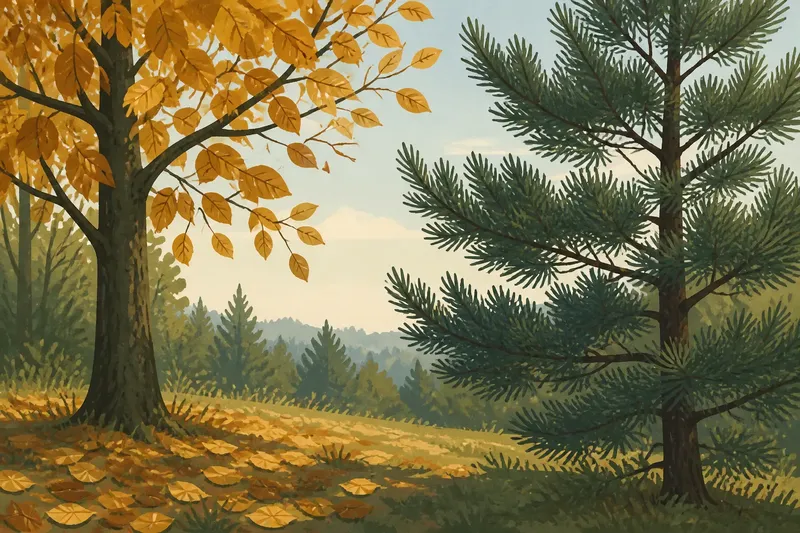
Why does a pine present a spray of slim needles while a beech spreads broad, flat leaves to the same daylight? Needles or broad leaves are two distinct ways plants arrange their working surfaces in air, shaping how they receive light and respond as seasons change. A closer look at their outline, orientation and timing turns a familiar tree into a readable piece of living architecture.
What does a leaf’s shape actually change?
Leaves take in light and exchange gases with the air. A broad leaf lays a comparatively large, flat surface across the light; a needle presents a narrow one, often with a rounded or ridged profile. These are not simply different silhouettes. They alter how much leaf surface faces the sun and how much air moves around it.
Hold a paper card flat to a lamp, then turn it edge-on: its exposure changes with its angle. A leaf is not a card, but the comparison helps explain why orientation matters. Broad leaves can intercept plentiful light across a wide blade, while needles in a dense cluster may receive light from several directions and leave gaps through which air and light can pass.
Neither shape works in isolation. A plant’s success also depends on its habitat, the arrangement of its branches, the thickness and surface of its leaves, and the conditions it faces. Shape offers a clue to the plant’s approach, not a verdict on how well it will grow.
How do broad leaves spread their surface to light?
A broad leaf’s blade gives it a generous area for catching light. In a beech or maple canopy, leaves often overlap like shingles, with their stalks and blades angled to fill openings between neighbouring leaves. That arrangement can create a shaded interior below the outer crown, even on a bright day.
The broad blade also has more surface exposed to moving air than a narrow needle of similar length. Air passing over a leaf can carry away heat and water vapour. In dry, sunny or windy conditions, a broad leaf may lose water faster if its supply cannot keep pace, so many broad-leaved trees shed their foliage before a cold or dry season.
Seasonal leaf fall is not a universal response among broad-leaved plants. Some keep leaves through winter, and others grow in places where rainfall, rather than cold, sets the rhythm of leafing and dormancy. The useful question is not simply “broad or narrow?” but “what conditions does this plant meet, and when?”
Why do needles often remain through winter?
Many conifers retain their needles across seasons. Their narrow shape exposes less surface to the air than a broad blade might, and their firm, often waxy outer covering can help limit water loss. This matters in winter, when frozen ground may make water difficult for roots to take up even while wind and sun continue to draw moisture from foliage.
Needles are not invulnerable, nor do all conifers keep them indefinitely. Individual needles age and fall, sometimes a few at a time, while fresh growth appears. Some conifers shed most of their needles seasonally. A carpet of fallen needles beneath a tree can therefore be part of its ordinary cycle rather than a sign of trouble.
Needle shape also changes how leaves sit together. Spruce needles radiate around their twigs, while many pines gather needles in small bundles. These arrangements affect which surfaces meet the light and how rain, snow and air move through the crown. The word “needle” describes a family resemblance, not one identical design.
What can the canopy reveal about the seasons?
Seasonal roles become easy to see when you compare a deciduous broad-leaved tree with an evergreen conifer. In the growing season, the broad canopy can spread a dense layer of leaves; as colder or drier conditions approach, many such trees drop them. The open branches then admit more light to the ground and expose the shape of the crown.
An evergreen’s retained foliage keeps presenting leaf surface through the year, although growth and activity may slow in cold conditions. Needles can continue to receive light on clear winter days, but their presence does not mean the plant can draw freely on frozen soil. Evergreen describes foliage retention, not constant growth.
Imagine you are looking at a mixed woodland edge in autumn: a beech has begun to thin while a nearby pine remains green. Watch how the opening canopy changes the light beneath the beech, then compare the pine’s dense, year-round outline. The visible result is a seasonal shift in which parts of the woodland are shaded, not a simple contest between one leaf type and another.
How can you read needles or broad leaves outdoors?
To observe how needles or broad leaves meet light and air, look beyond a single leaf. Notice where the plant grows, how its branches are angled, and whether the foliage forms a layered canopy or a loose spray. These details help explain why a leaf’s shape makes sense in its setting.
- Compare the outline. Is the leaf broad and flat, or narrow and tapered? Look for differences in thickness and surface as well.
- Check its angle. See whether leaves face upwards, sideways or in several directions around the twig.
- Look through the crown. A dense canopy may shade its own lower branches; a more open one may let patches of sky show between leaves.
- Notice the season. Watch for colour change, thinning foliage, fresh growth or shed leaves rather than assuming every tree follows the same calendar.
- Inspect the ground beneath. Fallen broad leaves and shed needles can reveal what the plant has been replacing, though neither litter type alone identifies a problem.
These observations are especially useful when trees grow close together. A broad-leaved sapling beneath a conifer may have a very different light supply from one at a woodland edge, even if both belong to the same species. The surrounding canopy is part of the leaf’s working conditions.
What questions help distinguish the two leaf strategies?
Are all needle-bearing trees evergreen?
No. Some conifers shed their foliage seasonally, while others retain needles or scale-like leaves through the year. Check the whole tree over time rather than treating “conifer” and “evergreen” as interchangeable.
Do broad leaves always lose more water?
A broad blade exposes a large surface, but water loss also depends on its outer covering, the weather and the plant’s control of gas exchange. Shape is one part of the explanation, not enough by itself to predict what a particular tree will do.
Can you identify a tree from its leaves alone?
Leaf shape can narrow down possibilities, but several plants have similar-looking foliage. Check how leaves attach to the twig, their arrangement, the bark and, when present, flowers or cones before settling on an identification.
Why do some broad-leaved trees keep their leaves in winter?
Some species retain foliage, and some young or sheltered trees hold dead leaves for part of the cold season. Climate, species and individual conditions all matter, so winter leaf retention does not automatically mean that a tree is evergreen.
What does leaf shape let you notice?
Needles or broad leaves reveal different ways of placing foliage in the flow of light and air. A flat blade can spread a broad surface across a bright canopy; a needle’s slimmer form and durable structure can suit foliage that remains exposed through harsher seasons. Neither strategy is a shortcut to understanding a whole plant.
Next time you pass a beech and a pine, pause at the edge of their crowns. Look for where the light gets through, which branches carry foliage, and what has fallen below. Those small details make the difference between merely naming a leaf and noticing how a plant meets its surroundings.