Why a Spider Web Catches Morning Dew
Why a spider web catches morning dew: learn how silk, surface tension and cooling air reveal droplets, and how to tell dew from rain outdoors.
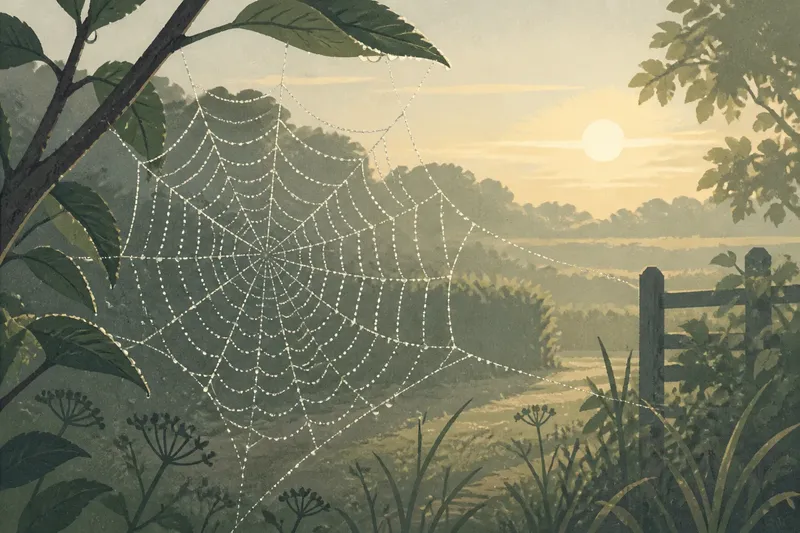
Why a spider web catches morning dew becomes clear on a cool morning, when a garden orb web shines with beads while nearby leaves look almost dry. The droplets have not necessarily fallen from the sky: water vapour in the air has condensed on the silk, and the web’s fine threads make that small change easy to see.
Why does dew appear on a web?
Air contains water vapour, even when the morning feels crisp. As the ground and nearby objects lose warmth overnight, the air next to them cools. If a surface becomes cool enough for water vapour to condense, liquid droplets form on it. This is dew.
A web can reveal the process particularly well because it is made of extremely slender strands arranged in open space. Each thread presents a narrow surface for moisture to gather on, and neighbouring strands create a pattern that the eye can follow. The web acts less like a sponge than like a fine drawing picked out in droplets.
Silk also has varied properties. A spider’s web may include different kinds of thread, and their surfaces do not all interact with water in precisely the same way. Some parts can collect beads, while other stretches remain comparatively clear. The arrangement of droplets can therefore trace the web’s construction as well as the damp conditions around it.
How do silk and surface tension shape each bead?
Water molecules attract one another. At a droplet’s surface, that attraction creates surface tension, which tends to pull the water into a compact shape rather than letting it spread into an invisible film. On a thread, the result may look like a string of tiny pearls, though the spacing and size vary with the silk and the local moisture.
The thread gives the water a surface to cling to, while surface tension helps hold each bead together. Gravity acts in the other direction, drawing the water down. On a delicate web, droplets can gather along the silk without immediately sliding away, especially when they remain small and the thread is steady.
Think of water beads on a waxed jacket: the fabric gives them somewhere to sit, but the water’s own cohesion helps keep them rounded. A spider web is far finer and more intricate than a jacket, yet the same everyday idea helps explain why moisture appears as distinct beads rather than a smooth coating.
Do not expect every web to look alike. A dense orb web may display a tidy geometry, while a tangled web in a hedge can hold an irregular scatter of droplets. Silk thickness, strand layout, exposure and the way water interacts with each surface all affect what becomes visible.
Why does cooling make the pattern appear at dawn?
Overnight, a web exposed to the open sky can lose heat and become cooler than the surrounding air. Nearby surfaces cool too, but a web’s thin lines are easy to overlook until water gathers on them. At first light, changing illumination catches the beads and turns otherwise faint strands into bright arcs or nets.
That timing explains why a web may seem to appear suddenly. The structure was already there; the droplets provide contrast. As the morning warms, the water can evaporate, and the web fades back into the background. A shaded hedge, a sheltered fence or a dew-prone patch of grass can offer different viewing conditions, so look from more than one angle.
Light matters as much as moisture for seeing the effect. Low sunlight can make droplets sparkle, while a bright sky behind the web may outline its strands against a darker hedge. Move slowly and change your viewpoint rather than touching the web: even a small shift in angle can bring a nearly invisible section into view.
How is dew different from rain?
Dew forms when water vapour condenses on a cool surface. Rain begins as liquid water in clouds and reaches the ground as falling drops. Both can leave a web wet, but their origins and patterns differ.
After rain, larger drops may cling to strands, and the web may appear disturbed by wind or by water moving across it. Dew often settles as many small beads along exposed threads, with the web’s fine structure still clearly visible. These are useful clues, not a certain diagnosis: drizzle, fog and changing wind can blur the distinction.
There is also a difference in what the web tells you. A rain-wet web records contact with falling water; a dewy web can show where a surface cooled enough for vapour to condense. The droplets are not a miniature weather gauge, but their presence invites a closer look at the web’s position, exposure and surroundings.
Which web should you look for, and how?
Different viewing approaches suit different readers and places. Choose the one that fits your surroundings and the kind of detail you want to notice.
- For a clear pattern: Look for an orb web between stems or branches. Its radiating lines and spiral can make droplets easy to follow, so this suits anyone curious about how a web is laid out.
- For a close-up of texture: Seek a small web in a sheltered hedge or among garden plants. A phone camera can help you inspect bead shapes later, making this approach useful when fine details are hard to see unaided.
- For comparing conditions: Notice webs in both an open patch and a sheltered corner. This suits a patient observer interested in how exposure changes what is visible, rather than in finding one especially dramatic web.
Say you find a web across a garden path after a cool, still night. From one side, its droplets vanish against the bright sky; from the other, they stand out against a dark hedge. If you pause, change your angle and look again later as the day warms, the expected observable result is a clearer view of the web’s structure at first, followed by beads that gradually become less conspicuous.
For a simple observation, note the setting rather than trying to identify every spider. Was the web open to the sky or tucked beneath leaves? Did the beads follow a regular spiral or gather unevenly? A few descriptive words can help you compare what you see on another cool morning without disturbing the silk.
What questions help explain a dewy web?
Does every spider web collect dew?
No. A web’s exposure, silk and surroundings affect whether moisture gathers and whether you can see it. Some webs may be present but remain too sheltered, too dry or poorly lit to stand out.
Why do droplets sit along the threads?
The silk provides a surface for water to collect on, and surface tension helps the water form beads. The exact pattern varies with the web’s structure and the way water interacts with its threads.
Can dew tell me whether it rained overnight?
Not by itself. Dew comes from condensation, while rain falls from clouds, but drizzle, fog and wind can leave overlapping signs. Consider the wider conditions as well as the web.
When is a web easiest to see?
Look after a cool, damp night, when light can catch droplets against a darker background. A low viewing angle or a small change in position may reveal strands that seemed to disappear from another direction.
What should you take away from the morning beads?
A dewy web brings together three modest forces: cooling air encourages condensation, silk gives water a place to gather, and surface tension holds droplets in visible shapes. The web’s delicate geometry makes the result unusually legible, turning moisture that might otherwise go unnoticed into a pattern you can inspect.
Next time you look for why a spider web catches morning dew, compare one exposed web with one tucked into a hedge, then watch how light changes each view. The beads may fade as the day warms, but their brief appearance can leave you better at noticing where water settles—and how much a change of angle can reveal.